
Most of us don’t enjoy sitting with our feelings — me included.
Because honestly… what are we even supposed to do with them?
Let them come?
Then what?
Cry? Journal? Talk to them?
Sure, sometimes it helps. But do we really want to sit with uncomfortable emotions again and again?
It feels cringey, uncool, and honestly… exhausting.
Why We Avoid Our Emotions
Sitting with our emotions means facing the very things we spend years trying to suppress — our sadness, loneliness, self-doubts, old wounds, unmet needs...
And once these emotions show up, we often don’t know how to handle them.
It’s not like we can spend an entire day drowning in feelings — that doesn’t help either.
So we do what most adults do:
distract ourselves with work
overfill our schedules
scroll for hours
binge TV
eat or stay busy
These distractions work… until they don’t.
Eventually:
You stop feeling anything at all (emotional numbness), or
Everything hits at once (emotional overwhelm)
Deep down, we know distractions don’t heal.
They only delay what needs to be felt.
Why Sitting With Emotions Feels Impossible
Here’s the truth:
Sitting with your emotions is not a quick fix.
It’s a slow, gentle process.
A long-term unlearning of everything we were taught about “being strong” and “moving on.”
It asks us to look inward — at our memories, our losses, our fears, the emotions we never processed.
And this is a lot to do alone.
In fact, it's almost impossible to do so if didn't grow up around emotionally regulated adults. It's not a skill we are born with, but one we learn through others.
What Is Emotional Regulation and Why Is It Important?
Emotional regulation isn’t about “controlling” your feelings or forcing yourself to stay calm.
It is the capacity to understand, tolerate, and respond to your emotions in a way that supports your well-being — instead of overwhelming your system or shutting it down.
At its core, emotional regulation is the ability to:
Notice what you’re feeling (before it spirals)
Make sense of the emotion (why it’s here, what it’s signaling)
Stay grounded enough to choose your response rather than reacting from survival mode
This ability may sound simple, but it’s actually a complex interplay between the nervous system, the mind, and our relationships.
Why does it matter?
Because when you can regulate your emotions, you gain:
Clarity (your thinking brain stays online)
Stability (stress doesn’t hijack your body)
Better relationships (you communicate rather than react)
Resilience (you recover from triggers faster)
The real purpose of emotional regulation isn’t to avoid anger, grief, fear, or shame.
It’s to build the internal stability needed to move through them without collapsing or exploding.
It helps you shift from:
reactive → responsive
surviving → choosing
shutting down → staying present
fearing emotions → understanding them as signals
Emotional regulation creates safety — the foundation on which every other form of healing rests.
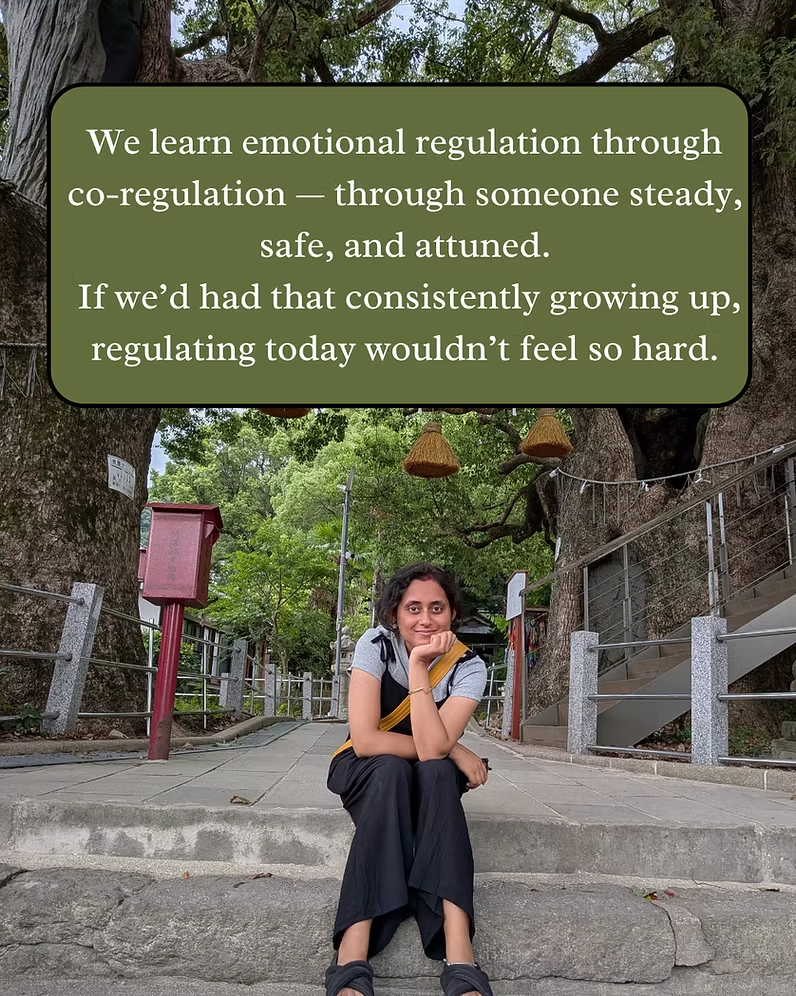
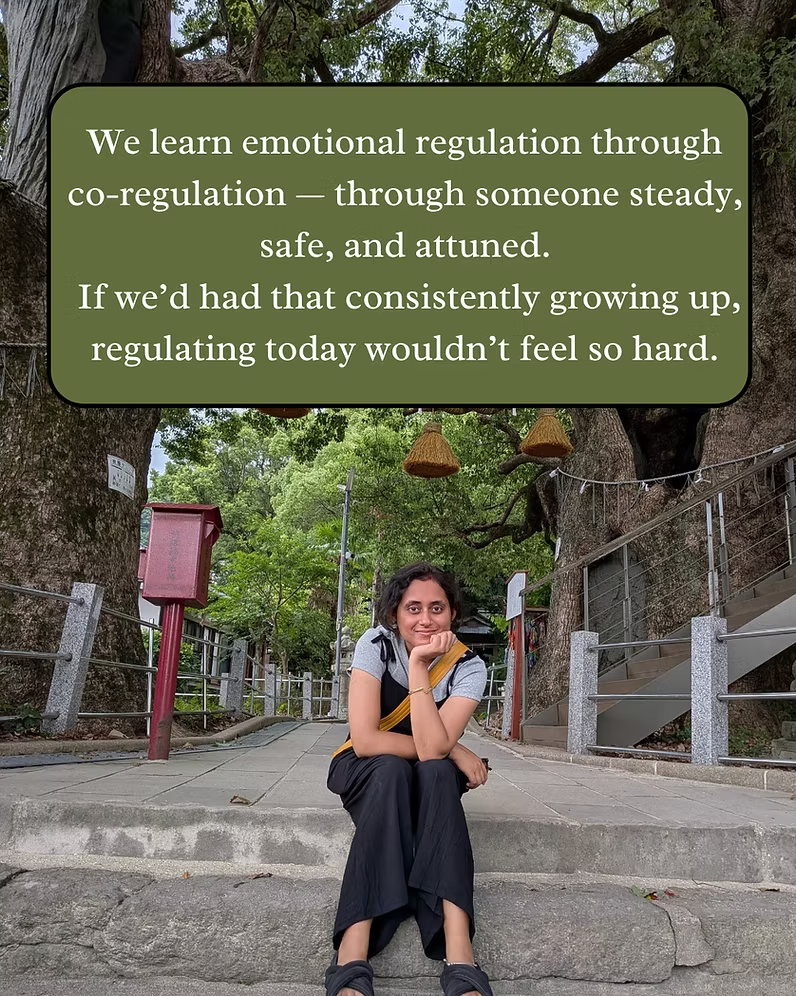
Sadly however, we’re not born with these skills — we learn them through co-regulation, by being around emotionally attuned adults.
We learn to feel safe and regulate our own emotions when we have people who could sit with their own feelings and hold ours. Someone who could provide a calm, safe and steady presence to help us understand our feelings and process them.
If that wasn’t consistently available, our nervous system may not have learned how to handle big emotions safely. As adults, this shows up as overwhelm, shutdown, reactivity, or relying on distraction.
If we never had that…it’s understandable that emotional processing feels overwhelming now — not because we’re weak, but because we never had a model for this. Because emotional regulation skills for adults start with co-regulation in childhood.
How to Develop Emotional Regulation Skills as an Adult
As a child growing up, you may not have had the kind of support needed to become an emotionally regulated adult. But you can still begin now.
Here’s what actually helps:
1. Seek Co-Regulation
Find someone who is emotionally steady and willing to be present for you: a friend, partner, a support group.
Let your system experience calm through another regulated nervous system.This is one of the most effective emotional regulation techniques for adults.
2. Practice in Small Moments
Start with:
noticing when you feel activated instead of numbing
placing a hand on your chest
naming the feeling without needing to judge or fix - "I feel _____"
grounding through breath or touch
pausing before reacting
Small practices build emotional strength over time.
3. Try Therapy for Emotional Regulation
If available to you, working with a therapist can help you:
understand your patterns
learn new coping strategies
provide a safe presence for your emotions
process old emotional wounds
build long-term regulation skills
You can look for a therapist who specifically works with emotions-focused approaches like EFT, AEDP, Somatic Experiencing, Sensorimotor Psychotherapy, IFS, CFT and Psychodynamic / Attachment-Focused Models.
4. Build Emotional Resilience Slowly
Healing doesn’t require perfection. It requires willingness — to come back to yourself, again and again.
Yes, emotional processing is hard.
Yes, it feels easier to distract yourself.
And yes — it becomes overwhelming when you’re doing it without support.
But it gets easier when someone steady is beside you.
You may have missed that support in the past…but you can begin now.
Find a safe space.
Reach out.
Let yourself be held in the process.
Because healing is a journey — and it becomes easier when you don’t have to take it alone.
Hey there, thanks for reading my blog. If you’re new here, you might consider checking out my other blog posts too. Happy Reading!